

Warsaw, August 13, 2026
OPEN APPEAL TO INTERNATIONAL JOURNALISM ASSOCIATIONS
AND PRESS FREEDOM ORGANIZATIONS
To:
Presidents, Executive Boards, and Human Rights Committees of International Press and Journalism Organizations (International Federation of Journalists, Reporters Without Borders, International Press Institute, Committee to Protect Journalists, Global Press Networks, Foreign Correspondents’ Club of Japan)
Re: Appeal for International Media Engagement in the Case of Mr. Christopher Stephan Payne (Japan) — Quashed Conviction, DNA Evidence, Pre-Trial Detention, International Standards, and Humanitarian Concerns
Dear Colleagues and Defenders of Press Freedom,
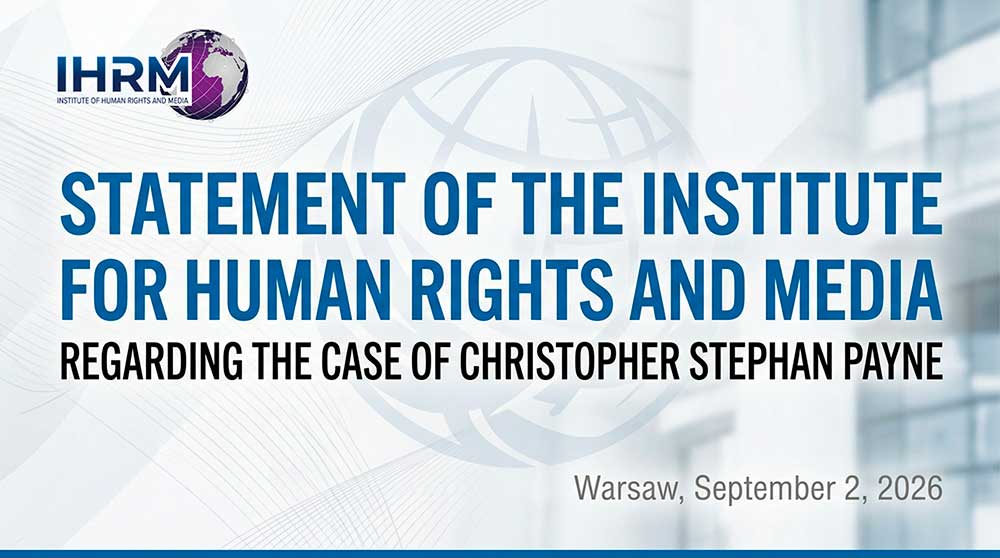
On behalf of the Institute of Human Rights and Media, an independent non-governmental organization based in Poland devoted to the protection of human rights, procedural fairness, and transparency in public information, we submit this appeal — an appeal that goes beyond a single case and raises fundamental questions about the treatment of individuals whose fate depends on state institutions, and about the role of the press as a voice of conscience, an instrument of oversight, and a guardian of truth.
The case concerns Mr. Christopher Stephan Payne, a United States national currently held at Chiba Prison in Japan, awaiting retrial before the Chiba District Court.
How the Institute Became Involved
The Institute of Human Rights and Media became aware of Mr. Payne’s case through information shared by several individuals on LinkedIn, which subsequently led us into direct contact with persons closely involved in supporting him. Under its Statute, the Institute is mandated to defend human rights — with particular emphasis on the right to information — and to cooperate with international institutions and organizations for the protection of human rights and media freedom, including through participation in judicial and administrative proceedings on behalf of aggrieved persons, both in Poland and abroad. Engaging in Mr. Payne’s case falls squarely within this statutory mandate.
Procedural Context and Factual Background
Quashing of Conviction by the Tokyo High Court (December 11, 2025)
The Tokyo High Court set aside the July 2024 conviction and remanded the case for retrial. In its reasoning, the High Court identified the need to re-examine the forensic analysts’ methodology regarding DNA mixture interpretation — specifically the evaluation of the presence of, and justification for excluding, a genetic profile belonging to neither the defendant nor the victim.
Decision of the Supreme Court (June 1, 2026)
Following the Supreme Court’s decision not to accept further appeal, the case was returned to the Chiba District Court for retrial, and Mr. Payne remains in pre-trial detention.
DNA Evidence and Challenged Methodology
According to submissions by the defense, supported by independent experts, serious concerns have been raised regarding the integrity of DNA data processing and the assumptions underlying probability calculations, warranting an independent forensic audit.
Alibi Evidence — Mobile Phone Location Data
The defense has presented mobile phone location data indicating that at the time of the alleged offense, Mr. Payne was in a different location than the scene of the crime.
Isolation and Health Condition
Mr. Payne remains detained under conditions described by legal experts within the framework of “hostage justice” (hitojichi shihō). This term is used by human rights monitors and foreign correspondents to describe Japan’s high rate and length of pre-indictment/pre-trial detention, limited bail, and interrogation practices. According to reports provided by defense counsel, the detainee’s health has significantly deteriorated, marked by documented medical episodes. According to defense counsel, the retrial is not expected to begin before spring 2027.
Humanitarian Principles and International Standards
In accordance with the Universal Declaration of Human Rights (Articles 3, 5, 9, 10, 11) and the International Covenant on Civil and Political Rights (Articles 7, 9, 10, 14), every person deprived of liberty is entitled to the following fundamental rights:
The presumption of innocence until proven guilty according to law.
A fair and public hearing by an independent and impartial tribunal.
Treatment with humanity and respect for inherent dignity — including access to adequate medical care, communication with family and legal counsel, and detention conditions adhering to international standards.
Protection against prolonged pre-trial detention without a final judgment, particularly in situations where the underlying evidence has been set aside by a higher court.
Mr. Payne’s situation touches directly upon all these domains. The setting aside of his conviction by the High Court indicates that the initial judgment failed to meet rigorous standards of evidentiary reliability. Nonetheless, the accused remains isolated in prison without the possibility of bail, awaiting a trial that may not commence for many months.
The Human Dimension
In a cell where the light never turns off, time can lose its meaning, and even the smallest human contact — a conversation, a smile — may become something to long for. Human beings need the presence of others as much as they need air and water; when a justice system denies its own suspects that basic need for months on end, it risks harming the very people it exists to serve. Judicial errors can happen, precisely because those who administer justice are not infallible — and it is for that reason, and because no lost time can ever be returned, that detention of this kind, imposed after a conviction has already been quashed, may be difficult to justify on security grounds, and may be perceived by some critics as an instrument of pressure rather than a safeguard of a fair trial.
Justice and the Role of Journalism
Justice does not consist merely in handing down sentences. It consists in ensuring that verdicts are sound, based on evidence that withstands the test of time and independent verification. When an appellate court quashes a conviction citing doubts over evidentiary methodology, yet the accused remains imprisoned, justice ceases to be unwavering and risks becoming a mechanism detached from its core purpose.
Truth carries inherent risks — sometimes even risks to personal safety. Yet that is precisely why investigative journalism possesses immense power: it can expose abuses, and it can restore hope to those who have lost it. In cases of an international nature, foreign correspondents often provide critical momentum to matters that receive inadequate coverage in local media — not as a critique of local press, but as an acknowledgment of the indispensable role international media plays in restoring balance, always with due respect for the legal traditions and cultural context of the country concerned.
Our Appeal to the Journalistic Community
While fully respecting editorial independence and institutional autonomy, the Institute of Human Rights and Media respectfully appeals to international journalistic associations and press freedom organizations to:
Encourage Investigation and Analysis
Urge investigative journalists and foreign correspondents to examine the case of Mr. Christopher Stephan Payne through the lens of fair trial standards, the reliability of scientific evidence, and fundamental human rights, including through dedicated editorial briefings or press notes summarizing procedural milestones and open questions.
Facilitate Information Exchange
Support platforms — e.g., a joint webinar or press briefing — where defense counsel, forensic experts, and representatives of non-governmental organizations (including Innocence Project Japan) may present verified procedural facts and developments to members of the press.
Monitor Conditions of Detention
Draw attention to the humanitarian aspects of Mr. Payne’s prolonged pre-trial detention pending retrial, including access to adequate medical care and compliance with international standards, and, where appropriate, issue public statements or letters of concern to relevant Japanese authorities.
Support Journalists Covering the Case
Provide institutional support and protection to journalists who undertake reporting on this matter, recognizing the potential sensitivities surrounding international judicial investigations, including safety guidance, legal risk briefings, and coordination with local fixers.
Why This Case Matters to Journalists Worldwide
Reliability of Scientific Evidence in Criminal Trials
Raises fundamental questions about the evaluation of DNA evidence and quality control mechanisms in judicial systems.
Right to a Fair Trial
The quashing of a conviction by a higher court underscores critical procedural and evidentiary questions.
Detention Conditions and “Hostage Justice”
Fits into the global dialogue surrounding prolonged pre-trial detention (hitojichi shihō), as noted above in the section “Isolation and Health Condition,” where the term is explained in the context of Japan’s high rate and length of pre-indictment/pre-trial detention, limited bail, and interrogation practices.
Role of International Media
History confirms that foreign coverage frequently opens necessary avenues for transparency in complex domestic cases.
Universal Value of Human Life
Reaffirms that human dignity and life are universal values that transcend borders and jurisdictions.
For press freedom organizations, this case raises core questions about the media’s role in scrutinizing the use of scientific evidence in criminal trials, the transparency of judicial processes involving foreign nationals, and the humanitarian impact of prolonged pre-trial detention. Coverage of such cases reinforces the global norm that fair trial standards and human dignity are not negotiable, regardless of jurisdiction.
Contact and Additional Information
The Institute of Human Rights and Media remains at your full disposal for informational inquiries. All materials referenced in this appeal — including procedural documents, expert analyses, and medical documentation — can be made available directly by Mr. Payne’s support group via the dedicated email address: justice4chrispayne@gmail.com. Should you wish to establish direct contact with Mr. Payne’s legal defense team, the support group will gladly facilitate such contact and provide relevant background documentation.
Yours sincerely,
Agata Ogrocka
President of the Board, Institute of Human Rights and Media
Krzysztof Wietecha
Director of International Affairs and Public Relations, Institute of Human Rights and Media




Leave A Comment